
Key Takeaways:
- Primary Clinical Command: The remote supervising radiologist holds primary authority for clinical decision-making during an adverse contrast event, including issuing the explicit directive to activate emergency medical services—but this command structure activates immediately following the onsite technologist’s critical first-responder actions.
- Technologist Autonomy in Severe Events: Onsite technologists are trained, qualified, and contractually expected to call 911 immediately for severe, life-threatening reactions without waiting for remote radiologist authorization—a critical operational distinction that facility directors must carve directly into written protocols.
- Established Regulatory Framework: The Centers for Medicare & Medicaid Services (CMS) finalized virtual direct supervision for diagnostic tests under the permanent Medicare Physician Fee Schedule rule that took effect on January 1, 2026. The American College of Radiology (ACR) supports this remote paradigm when synchronous audio-video connectivity and rigorous onsite emergency preparedness are maintained simultaneously.
- Sequence-Driven Escalation: Clinical response follows a strict, rehearsed timeline split into three distinct segments: 0-2 minutes, 2-5 minutes, and 5-10 minutes. Each window enforces distinct role obligations that must be simulated through mock-code training rather than assumed.
- Audit-Ready Documentation Requirements: Documenting an adverse contrast reaction is an active component of the emergency response, not a retrospective administrative task. Precise, timestamped logging must begin mid-incident to secure direct legal protection, inform future patient care, and insulate the facility against federal reimbursement recoupment.
- Operational Implication for Directors: For imaging center executives and operations directors managing remote contrast coverage programs, defining exactly who activates emergency services is a high-stakes operational and liability question that demands a finalized written answer before the next scan runs.
The Remote Radiologist Directs—But Not Always First
The remote supervising radiologist is the definitive clinical authority during a contrast media reaction. When complex treatment decisions must be executed, escalation pathways activated, or emergency medical services deployed, that clinical direction originates from the radiologist. This establishes a clear, legally defensible chain of command. There is, however, an indispensable operational qualifier: the remote radiologist is not always the first person to initiate the emergency call.
The first two minutes of an adverse contrast event belong completely to the onsite technologist. Because a remote radiologist cannot physically step into the room to intervene, a patient experiencing an immediate, life-threatening crisis cannot afford a single second of delay waiting for remote visual authorization before someone in the scanning suite takes action.
Modern clinical protocols are built explicitly around this physical reality. Understanding precisely how these two distinct roles divide decision-making authority—and identifying where their responsibilities overlap—is the factor that separates a compliant, safe remote contrast program from an unstandardized workflow that introduces severe clinical and legal liability. A structural analysis of decision authority and sequence-based escalation paths demonstrates how this division operates in practice.
Two Roles, One Protocol
Remote contrast supervision works across multi-site networks because onsite and remote roles have distinct responsibilities that form a coordinated system. Clear boundaries enable quick emergency response; ambiguity causes delays, risking patient outcomes.
Onsite Technologist: First Responder
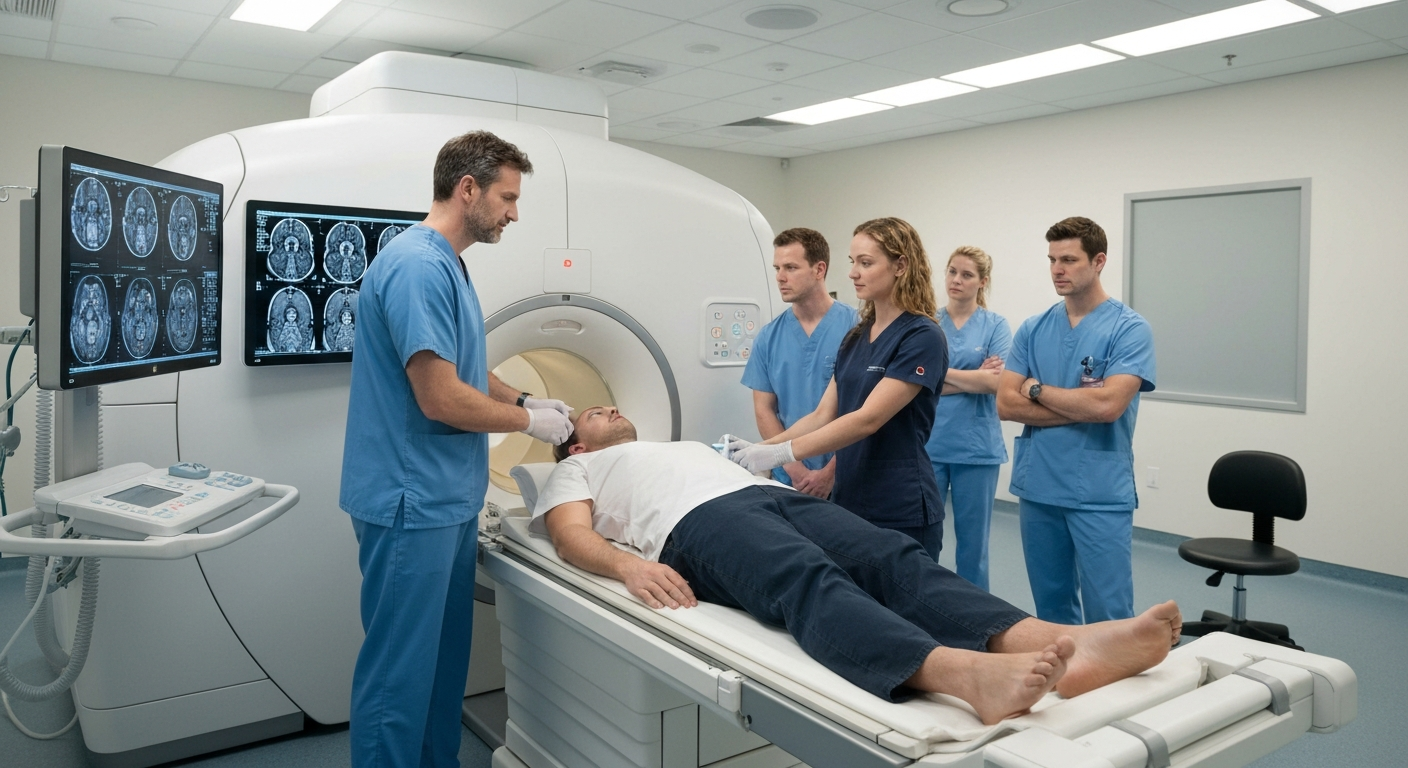
The onsite technologist acts as the immediate first responder on the ground. As the only clinical professional physically present with the patient inside the scanning suite, their immediate duties upon symptom onset include:
- Halting the contrast injection immediately.
- Conducting a rapid physical assessment of the patient using standard ACR reaction classification criteria to determine if the event is mild, moderate, or severe.
- Activating the secure, low-latency audiovisual communication link to engage the remote specialist.
- Administering first-line emergency medications in strict accordance with standing physician orders.
Beyond direct clinical support, the technologist must manage the immediate physical environment. This requires clearing non-essential personnel from the room, ensuring the facility’s crash cart and emergency medication kits are physically accessible at the bedside, and providing a concise, real-time clinical status update to the supervising radiologist the exact second the audio-video connection goes live.
Remote Radiologist: Clinical Command
The moment the synchronous audio-video link is established, the remote supervising radiologist assumes absolute clinical command of the event. Operating through the real-time visual connection, the specialist initiates a rapid, structured clinical assessment. The radiologist systematically reviews:
- The exact type and total volumetric dose of the contrast agent administered.
- The precise timing of symptom onset relative to the injection.
- Current objective vital signs, allergy history, and patient premedication status.
- Onsite emergency medication inventories and available clinical tools.
From this assessment, the radiologist dictates specific treatment interventions matching ACR Manual on Contrast Media protocols, establishes rigid clinical reassessment intervals, and makes the definitive decision to escalate to emergency medical services if the patient’s indicators warrant advanced intervention. Concurrently, the radiologist maintains an independent, parallel log of every directive issued throughout the duration of the event.
When Technologists Call 911 Without Waiting
The standard, sequential chain of remote physician authorization is bypassed under one specific condition: a reaction that manifests as severe from the absolute outset.
When a patient rapidly presents with overt anaphylaxis, immediate loss of consciousness, or acute cardiovascular collapse, the onsite technologist does not delay care to wait for the remote radiologist to review the screen and authorize an escalation. The call to local emergency medical services goes out instantly and simultaneously with the technologist’s initial attempt to establish the remote audio-video link.
In severe contrast events, the primary clinical intervention is intramuscular epinephrine—and documented delays in its administration are directly correlated with worsened patient outcomes and escalated clinical risks. Waiting for an external consultation costs critical seconds that an unstable patient does not possess. This immediate technologist-driven activation is not an ad hoc workaround or a protocol violation; it is a core component of the safety model. Every outpatient imaging network utilizing remote supervision must carve this exact clause into its written emergency response guidelines to eliminate any clinical hesitation when a crisis occurs.
The Escalation Timeline That Governs Both Roles
The relationship between the onsite clinical team and the remote specialist is governed by a strict, sequence-based escalation timeline. The roles do not run in parallel indefinitely; they activate in a precise order tied to the clock.
0-2 Minutes: Technologist-Owned Response
The onsite technologist entirely owns the opening 120 seconds. During this window, the technologist stops the injection system, classifies the reaction severity, acquires an initial set of vital signs, opens the synchronous audiovisual communication platform, and begins administering localized medications per standing orders if the reaction is verified as moderate or severe. If the reaction is catastrophic from the onset, the technologist utilizes this window to call 911 immediately.
2-5 Minutes: Radiologist Takes Clinical Direction
By the two-minute mark, the remote supervising radiologist must be fully connected and actively engaged via the live audio-video feed. If the primary connection attempt encounters a technical failure, the technologist is contractually and operationally mandated to instantly execute the facility’s documented backup physician contact protocol. Once the visual link is active, the radiologist assumes clinical command, finishes the structured assessment, and issues targeted medical directives. A strict reassessment checkpoint is scheduled within 2 to 3 minutes to objectively measure the patient’s response to the initial intervention.
5-10 Minutes: Emergency Services Decision Point
If a moderate or severe contrast reaction fails to demonstrate clear, objective improvement by the five-minute mark, the definitive decision to activate emergency services must be finalized. The remote radiologist explicitly issues the medical directive to escalate, and the onsite technologist or a designated facility administrator executes the call to emergency services without delay.
Imaging centers situated more than ten minutes away from the nearest municipal emergency response unit bear a heightened regulatory and clinical obligation to escalate early. Local transport times compound any delay in the initial activation decision. That regional geography must be factored mathematically into the custom protocol design before a remote contrast examination is ever scheduled.
What CMS and ACR Require Onsite
The regulatory baseline for remote contrast coverage is rigid, with federal mandates and specialty-level standards reinforcing the same operational compliance floor.
Real-Time Audio-Video as a Compliance Floor
The regulatory framework authorizing this model is fully operational. CMS finalized virtual direct supervision for diagnostic tests under the permanent Medicare Physician Fee Schedule rule that went into effect on January 1, 2026. This rule specifies that the supervising physician must remain immediately available throughout the entire duration of the procedure via real-time, synchronous, two-way audio and video telecommunications technology.
The physician must be capable of actively viewing and directing the clinical care in the moment. The ACR completely affirms this standard, confirming that synchronous audio-video connectivity satisfies federal definitions of physician availability, provided that professionally trained onsite personnel and structured emergency workflows are active simultaneously. Telephone-only or asynchronous communication lines are explicitly non-compliant and will fail a retrospective federal audit.
Onsite Staffing and BLS Guidance
Lifting the requirement for a physical physician in the room does not minimize onsite staffing criteria. The ACR Manual on Contrast Media mandates that appropriately trained clinical personnel—including registered nurses or technologists possessing documented specialty training and competencies—must be immediately available in the room to recognize emerging reactions and safely administer emergency medications under remote guidance.
Furthermore, the ACR requires that at least one professional holding a current Basic Life Support (BLS) certification be immediately accessible in the scanning suite during every remotely supervised contrast procedure. These staffing rules are mandatory compliance criteria. Any imaging facility that cannot satisfy both the real-time connectivity standard and the certified onsite staffing floor is operating outside of compliance, regardless of the clinical qualifications of its remote radiologist network.
Documentation Is Part of the Emergency Response
In a remote supervision model, documenting a contrast reaction is a core clinical priority that must be handled mid-incident, rather than an administrative task deferred to the end of the day. It establishes the explicit chronological record required to secure legal protection, ensure continuity of care, and prove regulatory compliance during an audit.
A formal, comprehensive written incident report must be fully completed and locked into the system before the conclusion of the shift in which the reaction took place. Within a strict 24-72-hour window, the facility’s internal quality assurance committee must review the digital log to confirm that every timed checkpoint was met and to rectify any operational bottlenecks. Thorough, automated documentation at every interval is the single element that transforms an emergency event into an audit-defensible corporate record.
Structured Protocols Are the Difference Between Safe and Liable
The division of clinical authority under a remote contrast supervision model is absolute. The remote radiologist maintains full clinical command and explicitly directs emergency medical services activation in all standard scenarios. At the same time, the onsite technologist is authorized to act first and simultaneously during immediate life-threatening crises. Both professionals rely entirely on a formalized, written protocol that has been routinely rehearsed through simulated mock codes rather than assumed.
Outpatient imaging groups that treat remote coverage as an informal, unmonitored communication line expose their networks to catastrophic clinical and legal liabilities that a structured system eliminates. The federal CMS and ACR frameworks provide the regulatory boundaries. The responsibility of imaging center executives is to operationalize those mandates by deploying specialized, industry-standard virtual contrast supervision systems that integrate clear role definitions, timed escalation checkpoints, automated compliance logging, and accredited onsite training from day one.
Note: Information provided is for general guidance only and does not constitute medical, legal, or financial advice. Pricing estimates and regulatory requirements are current at the time of writing and subject to change. For personalized consultation on imaging center operations and virtual contrast supervision, contact ContrastConnect.
ContrastConnect
Las vegas
Las Vegas
NV
89109
United States


