Pennsylvania required cursive again in early 2026. Keyword data compiled by FancyText.dev puts one cursive letter at an estimated 13,000 U.S. searches a month.
DALLAS, TX, UNITED STATES, August 18, 2026 /EINPresswire.com/ — Cursive stopped being a requirement in most American classrooms after 2010, when the Common Core standards left it out and 41 states adopted them. The reversal has been just as quiet, and it is now well underway: state legislatures have spent the past decade putting cursive back on the required list.
North Carolina was among the first, passing its “Back to Basics” law in 2013. California expanded its own requirement with Assembly Bill 446, signed in the fall of 2023 and effective the following January, widening cursive or joined-italics instruction from grades three and four to grades one through six — it cleared the Assembly 79-0 on its final concurrence vote. Pennsylvania added its own requirement in February 2026, on votes of 195-8 in the House and 42-5 in the Senate. Idaho’s 2025 law sets a measurable bar: instruction beginning by third grade and cursive proficiency by the end of fifth. By Education Week’s 2024 count, roughly two dozen states require cursive instruction in some form — up from 14 less than a decade earlier — though the exact number depends on whether state academic standards are counted alongside statutes.
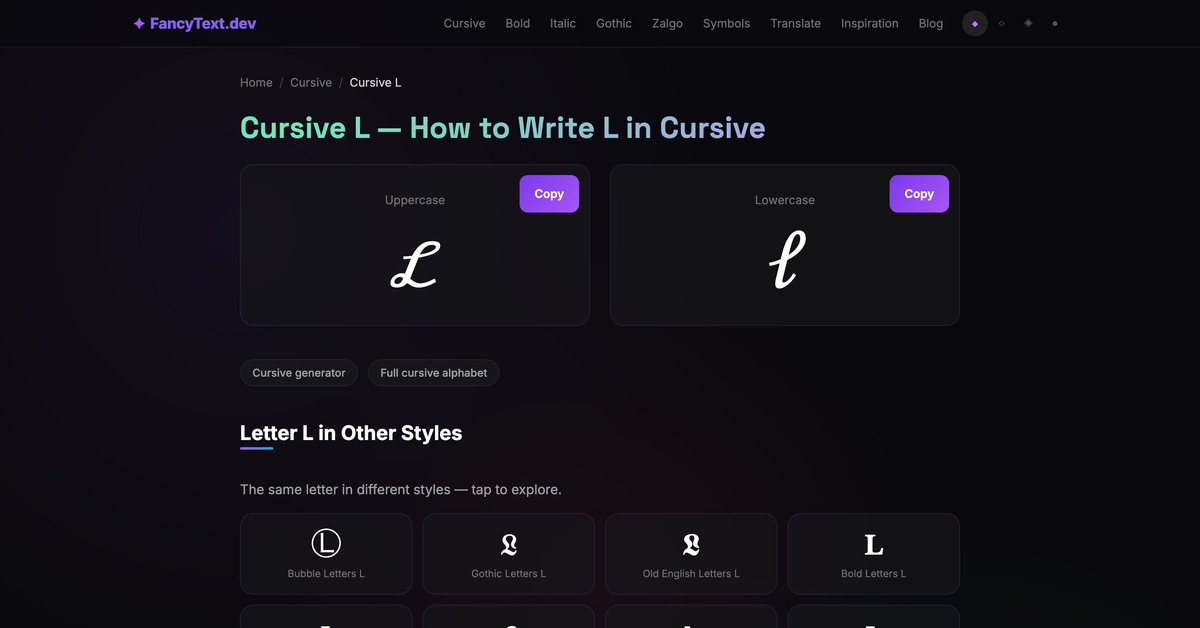
Outside the classroom, individual cursive letters draw search volume of their own. Third-party keyword data compiled by FancyText.dev, a free online text-style generator, puts U.S. search volume for the phrase “l in cursive” at an estimated 13,000 a month — one letter. Google’s autocomplete suggests the same single-letter pattern for other letters — “in cursive j”, “in cursive f” and “in cursive z” among them — alongside queries like “how to write a in cursive”, itself over a thousand searches a month. Keyword data can’t say who is searching or why. What it does show is that the volume sits on single letters rather than on words or sentences. (Figures are Ahrefs search-volume estimates, pulled August 2026.)
“The searches point at something the curriculum dropped,” said the FancyText.dev team. “Keyword data won’t tell you who is typing or why, but our read is that a lot of these are people signing something, helping with homework or writing a card, and one letter has gone. Legislatures are now trying to close that gap for the next generation.”
The votes have crossed party lines. California’s bill drew a single no vote across two Assembly floor votes; Pennsylvania’s requirement drew support from both parties. Advocates typically cite fine-motor development, reading historical documents and the practical business of signing one’s name.
FancyText.dev generates cursive, script and other styled text that can be copied and pasted into most apps and websites, along with reference pages for individual letters, free and without an account, at https://fancytext.dev. Styled text is produced using standard Unicode characters; support varies by platform, and cursive reference pages are intended as visual guides rather than formal penmanship instruction.
About FancyText.dev
FancyText.dev is a free online tool that converts ordinary text into cursive, script, bold, bubble and other styles for copying and pasting, with reference pages covering individual letters in each style. No account is required.
Media contact:
Media Relations, FancyText.dev
support@fancytext.dev
Media Relations
FancyText.dev
support@fancytext.dev
Legal Disclaimer:
EIN Presswire provides this news content “as is” without warranty of any kind. We do not accept any responsibility or liability
for the accuracy, content, images, videos, licenses, completeness, legality, or reliability of the information contained in this
article. If you have any complaints or copyright issues related to this article, kindly contact the author above.

Media gallery