

Key Takeaways
- Flyers work best for South Bay small businesses when the offer is simple, the audience is local, and the message has one clear call to action
- Checking San José’s handbill permit and objection-list rules before distribution can save a campaign from fines or wasted print runs
- QR codes, custom links, and promo codes turn a paper flyer into something a business can actually measure
- Coffee shops, car washes, daycares, dog walkers, real estate firms, and neighborhood restaurants are among the local businesses that tend to see the strongest results from flyering
- Testing a flyer’s QR code before the full print run goes out is one step many businesses skip, with consequences worth knowing about
Flyers might seem like a throwback in a world of social ads and email blasts, but for small businesses rooted in one neighborhood, a well-placed piece of paper still gets noticed. South Bay business owners who want to reach the people actually driving past their storefront or walking their dog nearby have a lot to gain from doing flyers right.
Why Flyers Still Win Local Customers
Flyering is a type of advertising that spreads a message through concise print materials, often handed out or posted in public places like community bulletin boards and telephone poles. Digital versions exist too, shared through email, blogs, social media, and paid ads, but the classic paper flyer still holds its own because it is tangible and hard to ignore. A flyer is also distinct from a brochure or pamphlet in one important way: it is a single page, while those other formats are typically folded or made of multiple pages bound together.
“What makes flyers worth a second look is how well people remember them,” says a spokesperson for outdoor ad specialist Special Interest Marketing & Advertising. “Flyers tend to stick in people’s minds more than many other advertising formats, and a large share of people who receive one will keep it, pass it along, or at least glance at it before tossing it. For a South Bay business trying to reach neighbors within a few miles, that kind of recall is hard to beat for the cost involved.”
Which South Bay Businesses Benefit Most
Flyering tends to pay off best for businesses that serve people nearby rather than customers scattered across a wide region. A dog walker, a car wash, or a daycare center depends on local parents and pet owners who live or work close enough to make the service convenient, and a flyer posted at the right corner store or gym can reach exactly that crowd.
Real estate professionals also see strong returns from flyering, since buyers and sellers usually want an agent who knows the neighborhood inside and out. Coffee shops, retailers announcing a grand opening, restaurants testing a new menu, and bars promoting a weekend event share that same local draw. The common thread across all these businesses is a customer base that already lives, works, or spends time in the immediate area, which is exactly the audience flyers are built to reach.
Designing a Flyer That Gets Read
A flyer only works if someone actually stops to read it, which means design matters as much as distribution. Every strong flyer follows the same basic structure: a visual hook, a headline, supporting text, and a call to action, presented in that order so the eye naturally moves from attention-grabber to next step.
Lead With a Visual Hook and Headline
The visual hook is whatever catches someone’s eye first, whether that is a bold headline, a striking image, or an eye-catching coupon design. Readable fonts, strong contrast, and enough white space keep the flyer from feeling cluttered, and any image included should support the message rather than compete with it. A flyer trying to do too much visually usually ends up doing nothing well, so simplicity at this stage pays off later.
Keep Copy Minimal and Add a Clear CTA
Once the hook grabs attention, the supporting text needs to stay lean. A strong headline, an eye-catching image, and only the essential details, like an address or hours, are enough; anything extra just dilutes the message. The flyer should close with one clear call to action, such as scanning a code, calling a number, or visiting during a specific window, rather than asking the reader to take several different actions at once. Adding a deadline to the offer can also create a sense of urgency that pushes someone to act sooner rather than setting the flyer aside.
Getting Your Flyer in Front of the Right People
A beautifully designed flyer does nothing if it ends up in the wrong hands, which is why distribution strategy deserves as much thought as design.
Match Locations and Timing to Your Audience
The best distribution spots are wherever the intended audience already goes, and for a reason connected to the offer. A yoga studio’s intro-month flyer might do better on a health food store’s corkboard than on a random telephone pole, while a flyer for a new car wash could find a receptive audience near a busy gas station or auto parts store. Complementary businesses, community events, and neighborhood hubs tend to outperform scattershot posting, simply because the people passing by already have some connection to the need the flyer addresses.
Posting, Handing Out, Bundling, or Going Digital
South Bay businesses have several distribution paths to choose from, and most successful campaigns combine more than one.
- Posting flyers publicly on message boards or poles works well for dog walkers, movers, landscapers, and anyone promoting a local event like a yard sale.
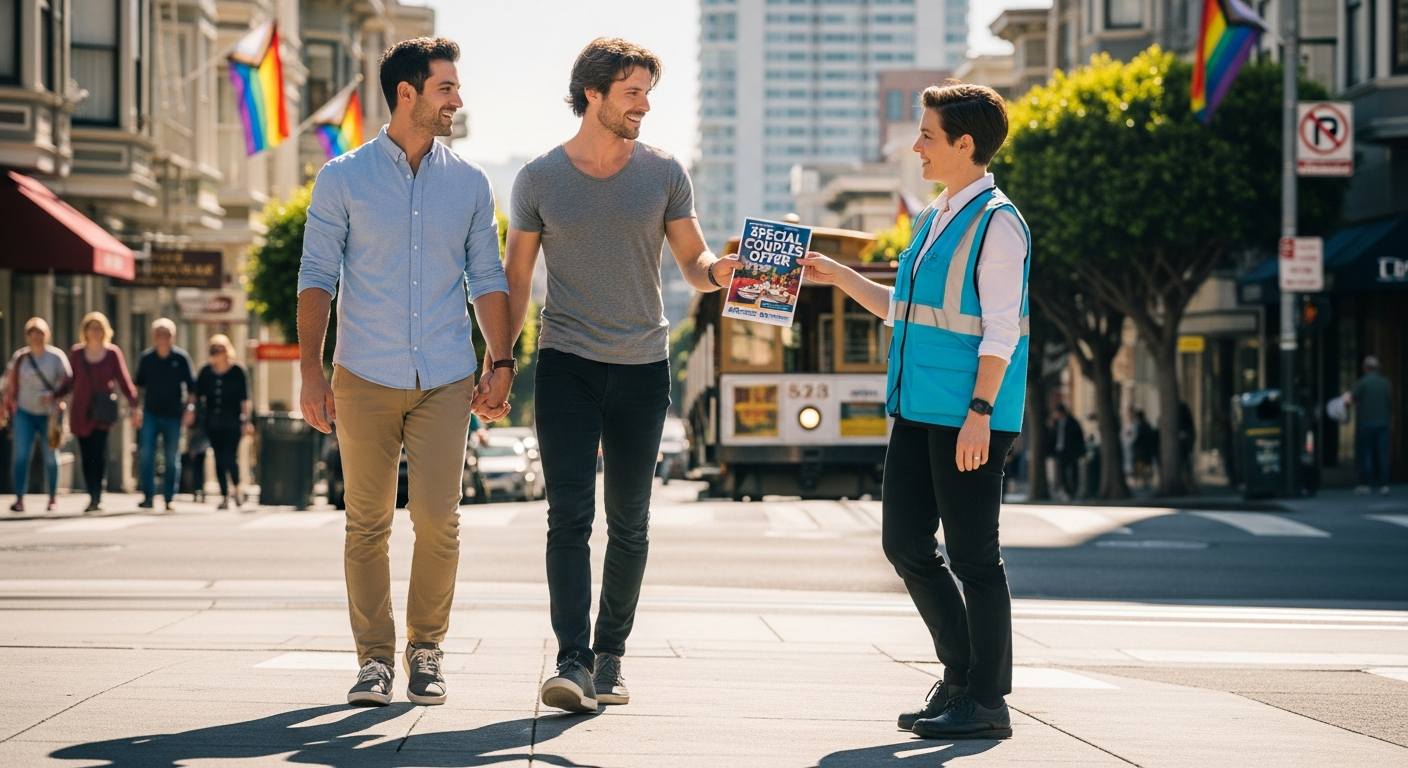
- Handing out flyers face-to-face puts a business owner directly in front of potential customers and opens the door to a quick conversation about the offer.
- Bundling flyers with another giveaway, such as tucking a coupon into every order or joining a local sponsorship package, adds value without asking for extra attention.
- Sharing flyers digitally through social media, email, or online community platforms extends reach beyond foot traffic, which helps a business stay in front of customers between in-person visits.
Know the Rules Before You Distribute
Flyering is generally legal, but local rules can restrict where, when, and how a flyer gets distributed. Skipping this step can turn an otherwise solid campaign into a wasted print run or a fine.
San José’s Handbill Permit and Objection List
Businesses distributing handbills in San José need a permit before they start, and the permit process may call for additional documents or approvals depending on the activity. San José also maintains an objection register, and properties on that list must not receive handbills at all. Beyond the register, the city bars handbill delivery to properties displaying a conspicuous “No Advertising” sign, vacant premises, and premises where earlier advertising has not been removed. Any handbill that is delivered also has to be secured well enough that it will not blow away, which matters on a windy afternoon near the bay.
Checking Public Posting and Private Property Rules
Public property comes with its own restrictions. Posting on poles, sidewalks, and other public fixtures may be limited by local rules, so it is worth checking the specific rules for a given spot before putting up a single flyer. Private property is simpler in principle but easy to get wrong in practice: permission should be asked for before leaving flyers at a privately owned business or pinning one to a community bulletin board, even when the board looks open to the public. A quick conversation with an owner or manager up front avoids an awkward conversation later.
Proving Your Flyer Campaign Worked
A flyer campaign without tracking leaves a business guessing whether the investment paid off, and that guesswork is avoidable with a little setup before the print run goes out.
Setting Up QR Codes, Links, and Promo Codes
A unique landing page tied to a QR code, a short custom URL, or a distinct promo code that staff can recognize at checkout all make a flyer’s results traceable. Using a different trackable code for each flyer batch can also help identify which neighborhood or distribution effort is actually generating engagement, which matters when a business runs flyers in more than one part of South Bay at once. Before the full run goes to print, the QR code should be tested on a printed proof to confirm it opens the correct destination and that the destination works properly on a phone. A high-contrast code on a light background, with clear space around it and no stretching, blurring, or graphics covering it, scans more reliably than a code squeezed into a tight corner. The flyer’s copy should also say what scanning the code will do, whether that is booking an appointment or finding more information, so the action feels obvious rather than optional. Setting up tracking parameters and analytics on the destination page before the code is finalized means the data is ready to read the moment flyers hit the street.
Measuring Visits, Bookings, and Redemptions
Scans alone do not tell the full story. The real measure of a flyer campaign is what happens after someone scans, calls, or walks in: a booking, a purchase, a review, or a signup. Separate tracking links for different offline marketing materials can help a business tell which piece, a flyer versus a postcard versus a table tent, actually drove the visit, which matters when more than one print tactic runs at the same time.
Simple, Targeted, Legal, and Trackable Flyers Win
Flyers remain a practical, affordable way for South Bay small businesses to reach the customers who matter most, as long as four things line up: a message that says one thing clearly, distribution aimed at people who already have a reason to care, rules that have been checked rather than assumed, and a tracking method built in from the start. Skipping any one of those steps tends to show up later as wasted print, a stalled campaign, or a fine nobody budgeted for.
For South Bay business owners ready to put these principles into practice, consider flyer distribution built around a route-by-route understanding of where the right local customers actually spend their time.
Special Interest Marketing & Advertising Inc.
610 16th Street
Suite 76
Oakland
California
94612
United States