How Modern Communication Infrastructure Is Creating the Channel’s Most Profitable Recurring Revenue
Alpharetta, United States – February 18, 2026 / SIPTRUNK /
White-label SIP trunking is a fast-growing revenue stream for IT resellers entering the telecommunications space.
-
The market is projected to exceed $181 billion by 2031, creating substantial opportunities for channel partners ready to diversify their offerings.
-
Resellers routinely achieve margins of 40% or higher without infrastructure investment or deep technical expertise in telecommunications.
-
Automated provisioning and billing systems eliminate the operational complexity that historically kept IT professionals out of voice services.
-
Small and medium-sized businesses are actively seeking trusted IT advisors to help them modernize their communications.
If you have been looking for a signal to move beyond one-time project fees and into predictable monthly recurring revenue, this is it.
Legacy phone systems that served businesses for generations are rapidly becoming obsolete, and the companies that relied on them are searching for guidance. For IT resellers, value-added resellers, and managed service providers, this shift presents an extraordinary opportunity to expand service portfolios while building sustainable income streams.
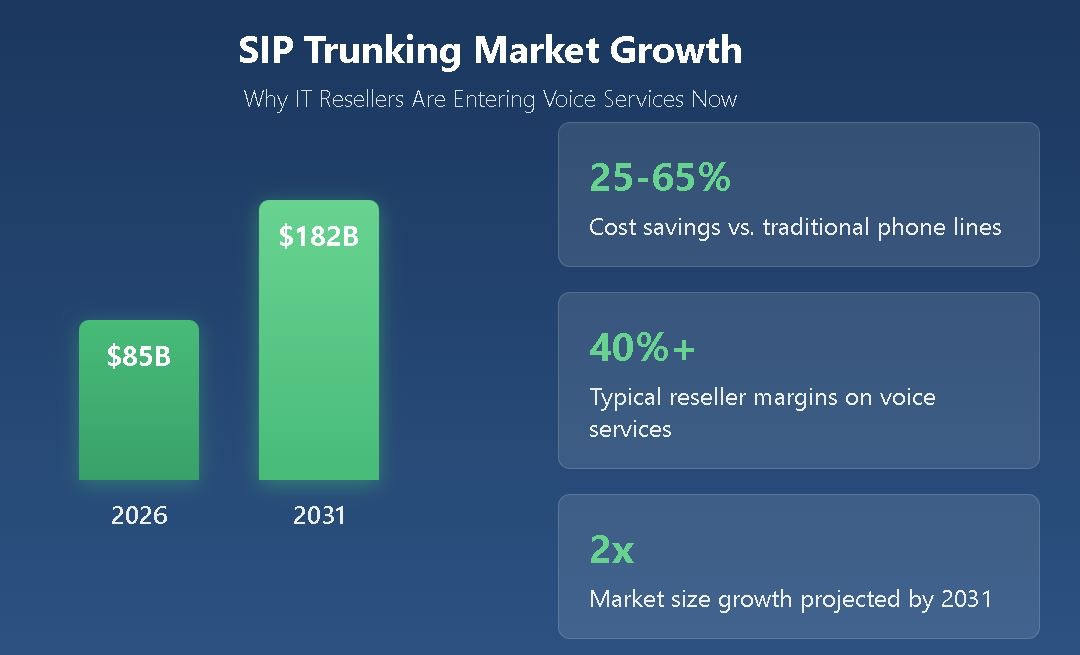
The SIP trunking market stands at $85.07 billion in 2026 and is projected to reach $181.58 billion by 2031. This growth is creating demand for white-label SIP trunking reseller partners who can bridge the gap between complex telecom technology and everyday business operations.
What Is White-Label SIP Trunking?
White-label SIP trunking allows IT channel partners to offer voice communication services under their own brand without building or maintaining telecommunications infrastructure. Unlike traditional agent or referral models, where customers interact directly with the service provider, white-label arrangements give resellers complete ownership of the customer relationship, pricing strategy, and brand presentation.
The distinction matters because it changes the economics of the relationship. Traditional commission structures might yield 15–20% on referred business, with limited control over service delivery or customer experience. White-label programs, by contrast, enable resellers to purchase services at wholesale rates and set their own retail pricing. This approach regularly produces margins of 40% or higher while positioning the reseller as the primary point of contact for all customer needs.
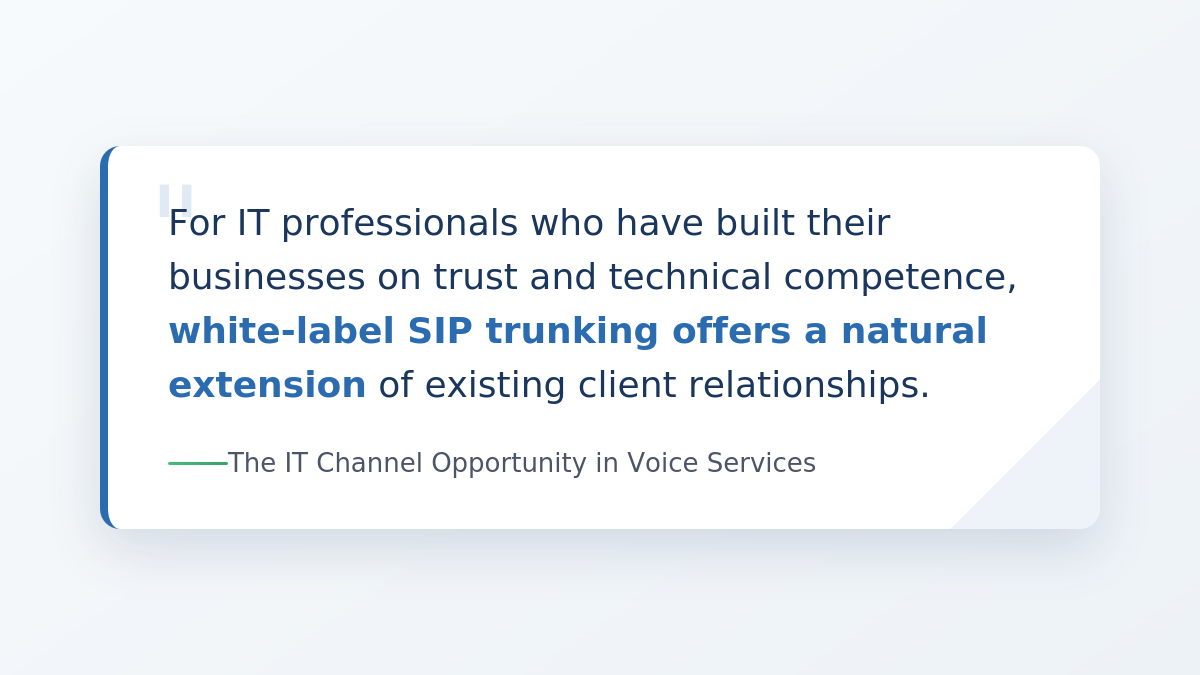
For IT professionals who have built their businesses on trust and technical competence, white-label SIP trunking offers a natural extension of existing client relationships. Your customers already rely on you for network infrastructure, security, and cloud services. Adding voice communications to that portfolio strengthens your position as their comprehensive technology partner.
How Does SIP Trunking Create Value for Your Clients?
Understanding the value proposition for end customers is essential for any reseller considering this market. Businesses switching from traditional phone lines to SIP trunking experience cost savings between 25% and 65% on their monthly communication expenses. These reductions come from eliminating dedicated copper lines, reducing long-distance charges, and consolidating voice and data onto shared internet infrastructure.
SIP trunking delivers flexibility that legacy systems can’t match. Businesses can scale their calling capacity up or down based on seasonal demand, add or remove locations without infrastructure changes, and implement advanced features like call routing and failover without expensive hardware investments. For companies with remote or hybrid workforces, SIP trunking enables seamless communication regardless of where employees are physically located.
The business continuity advantages are equally compelling. When traditional phone lines fail, businesses lose their connection to customers. SIP trunking automatically reroutes calls to mobile devices, alternate locations, or backup systems within seconds of detecting an outage. For organizations where missed calls translate directly to lost revenue, this resilience alone justifies the transition.
What Is Driving IT Channel Adoption of White-Label VoIP?
Several factors explain why IT resellers are adding white-label VoIP and SIP trunk services to their portfolios. The most immediate driver is the accelerating pace of digital transformation across every industry. Businesses that delayed technology upgrades for years are now racing to modernize, and communication systems are high on the priority list.
Regulatory and infrastructure changes are adding urgency to this transition. Telecommunications carriers worldwide are sunsetting legacy PSTN networks, forcing businesses to migrate whether they planned to or not. In this environment, companies are looking for advisors who can guide them through the transition without the confusion of dealing directly with large carriers.
The economics of traditional IT services have also shifted. Hardware margins have compressed, cloud migrations have reduced on-premise infrastructure projects, and managed services have become increasingly commoditized. IT channel partners who rely solely on these revenue streams face growing pressure on profitability. Adding recurring communication services provides diversification while leveraging existing customer relationships.
Why Are Managed Service Providers Leading the Charge?
Managed service providers occupy a particularly advantageous position in the white-label SIP trunking opportunity. Their business models already center on recurring monthly revenue, making the addition of communication services a natural fit. The same clients paying monthly fees for network monitoring, security, and cloud management represent warm prospects for voice services that integrate with their existing IT infrastructure.
The stickiness factor deserves attention as well. Clients using multiple services from a single provider are less likely to switch vendors than those with fragmented relationships. When an MSP handles network connectivity, security, cloud applications, and voice communications, the switching costs become substantial enough to create genuine customer loyalty. This dynamic improves retention rates while increasing the lifetime value of each client relationship.
From an operational perspective, MSPs already possess the support infrastructure and technical orientation needed to succeed in this market. They understand service level agreements, remote troubleshooting, and the importance of proactive monitoring. These capabilities naturally apply to voice services, reducing the learning curve and enabling faster time to revenue.
Five Reasons IT Resellers Are Choosing White-Label SIP Programs
The shift toward white-label SIP trunking among IT channel professionals reflects practical business considerations rather than mere trend-following. Understanding these motivations helps clarify whether this opportunity aligns with your own business objectives.
-
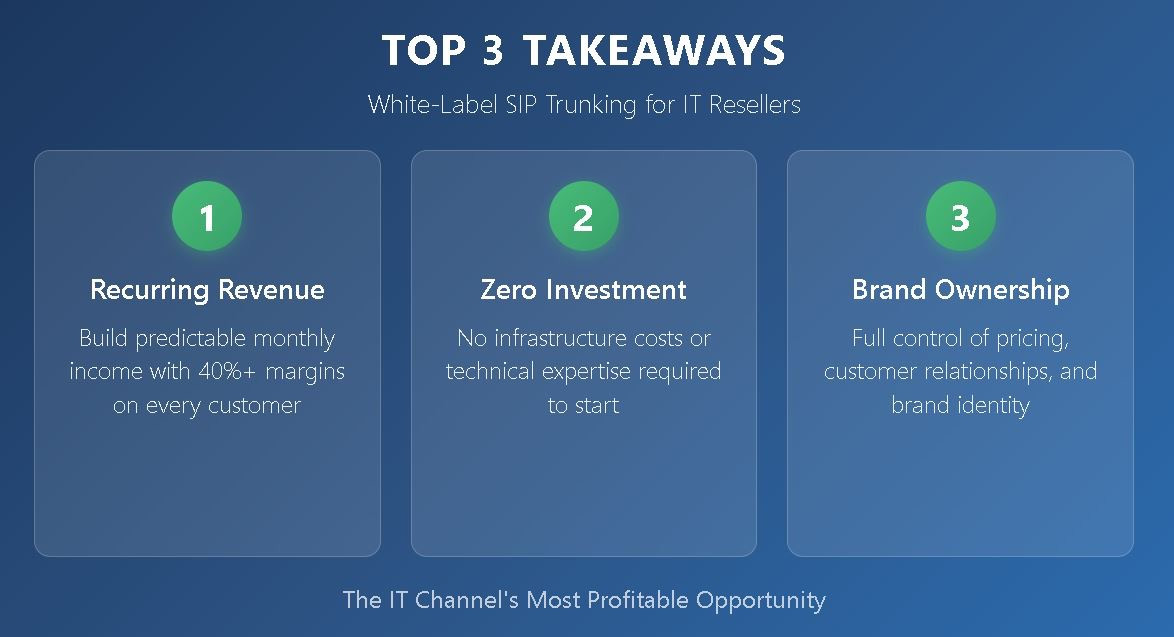
Recurring revenue without recurring headaches. Every customer you activate generates monthly income that continues as long as they remain on service. Unlike project-based work that requires constant new sales to maintain revenue, communication services create a predictable cash flow that compounds as your customer base grows. Many successful SIP trunk resellers report that voice services become their most profitable revenue stream within two to three years of launch.
-
Zero infrastructure investment required. Traditional telecom businesses required massive capital expenditures for switching equipment, network infrastructure, and data center facilities. White-label programs eliminate these barriers. Your platform partner owns and maintains the infrastructure while you focus on sales, customer relationships, and service delivery.
-
Automated provisioning and billing systems. Modern white-label platforms handle the operational complexity that would otherwise consume your time and resources. New accounts can be provisioned in minutes rather than days. Billing happens automatically based on usage and plan parameters. Support tools provide visibility into call quality, usage patterns, and potential issues before customers report them.
-
Brand ownership and client control. Your customers see your brand throughout their experience. Invoices, portals, and communications all reflect your company identity. This arrangement builds your brand equity rather than promoting someone else’s, and it ensures that customer loyalty accrues to your business rather than to an upstream provider.
-
Technical support handled by the platform partner. Concerns about telecommunications expertise often prevent IT professionals from entering this market. Quality white-label providers offer comprehensive training, technical documentation, and escalation paths for complex issues. You focus on what you do best while your partner handles the telecom-specific challenges.
What Does It Take to Become a SIP Trunk Reseller?
The barriers to entry for IT channel SIP programs have dropped in recent years. Most white-label providers have eliminated minimum purchase requirements, upfront fees, and long-term contracts that historically limited participation to larger organizations. Solo IT consultants and established MSPs alike can explore the opportunity without significant financial risk.
Technical requirements are similarly minimal. If you can navigate cloud management consoles and understand basic networking concepts, you possess the foundational knowledge needed to succeed. Providers typically offer certification programs, online training, and dedicated partner support to accelerate your learning curve.
The most important qualification is something you likely already possess: trusted relationships with businesses that need communication services. Your existing clients represent your initial target market, and your credibility with them gives you an advantage that no amount of marketing spend can replicate for new entrants.
How Quickly Can Resellers Start Generating Revenue?
Speed to market varies based on your approach, but many resellers complete onboarding and activate their first customer within days of partner agreement. Automated provisioning means that once you understand the platform, deploying service becomes straightforward. Early customers continue generating income while you acquire additional accounts, creating compound growth over time.
Realistic expectations matter here. Building a substantial recurring revenue stream requires consistent effort over months. However, the economics improve steadily as your customer base expands. Each new activation adds to your monthly revenue without proportionally increasing your operational costs, improving margins as you scale.
How Should IT Channel Partners Evaluate White-Label VoIP Opportunities?
Platform reliability should top your evaluation criteria. Your reputation depends on delivering consistent service quality, so investigate uptime guarantees, network redundancy, and the provider’s track record with existing partners.
Pricing transparency matters as much as the rates themselves. Hidden fees for features, support, or administrative functions can quickly erode margins. Look for partners who provide clear wholesale pricing without complexity, allowing you to build profitable service packages with confidence. The complete checklist for evaluating white-label VoIP solutions provides detailed criteria for this assessment.
Support and training resources often differentiate adequate providers from exceptional ones. Evaluate the depth of technical documentation, availability of partner support staff, and quality of sales enablement materials. Partners who invest in your success through comprehensive resources demonstrate commitment to the relationship beyond initial activation.
Frequently Asked Questions
What margins can IT channel SIP resellers expect? Margins vary based on your pricing strategy, service mix, and customer volume, but most established resellers achieve margins between 40% and 70% on voice services. Higher margins typically correlate with value-added services, premium support offerings, and strategic customer selection. The wholesale pricing model gives you control over your profitability in ways that commission-based arrangements can’t match.
Do I need telecom experience to resell SIP trunking? No telecommunications background is required to succeed as a white-label SIP trunking reseller. Quality platform partners provide training, technical support, and documentation that enable IT professionals to confidently deliver voice services. Your existing technology expertise and customer relationships matter more than industry-specific knowledge, which you will develop naturally as your practice grows.
How does white-label SIP trunking differ from becoming a traditional VoIP agent? Traditional agent relationships involve referring customers to a provider’s branded service in exchange for commissions. You have limited control over pricing, customer experience, or service delivery. White-label arrangements let you brand services as your own, set your own prices, and own the customer relationship entirely. This distinction translates to higher margins, stronger customer loyalty, and greater business value over time.
Build Your Recurring Revenue Stream Today
Market growth, technology accessibility, and changing customer needs have created an opportunity for IT resellers willing to expand into voice services. White-label SIP trunking removes the traditional barriers of infrastructure investment, technical complexity, and capital requirements, making this market accessible to channel partners of all sizes.
With no contracts, automated provisioning, and generous margins, SIPTRUNK provides the platform, training, and support that IT resellers need to launch and grow profitable voice practices.


Contact Information:
SIPTRUNK
3005 Royal Blvd S. Ste 120
Alpharetta, GA 30022
United States
Mitch Kahl
https://www.siptrunk.com/


